Search
1000 results for “fluiddyn”
-

I've made a poster for next week's #AGU meeting in Chicago. It is about my ongoing (and still exploratory) work on #TorsionalOscillations in the #FluidOuterCore of the #Earth.
#FluidDynamics #WhatAboutMagneticFields -

Friday means time for #FieldPhotoFriday (or if you prefer #FridayFieldworkPhoto #FridayFieldPhoto)
These were some of the first #IceFlowers I ever saw on #SeaIce this spring. Made me realise there was more going on in that part of the #Cryosphere than I'd imagined and I should pay it more attention!
Astonishingly beautiful and fragile, they grow on #SeaIceleads by evaporation+ condensation. Fascinating #FluidDynamics and surprisingly #salty tasting!
-

Friday means time for #FieldPhotoFriday (or if you prefer #FridayFieldworkPhoto #FridayFieldPhoto)
These were some of the first #IceFlowers I ever saw on #SeaIce this spring. Made me realise there was more going on in that part of the #Cryosphere than I'd imagined and I should pay it more attention!
Astonishingly beautiful and fragile, they grow on #SeaIceleads by evaporation+ condensation. Fascinating #FluidDynamics and surprisingly #salty tasting!
-
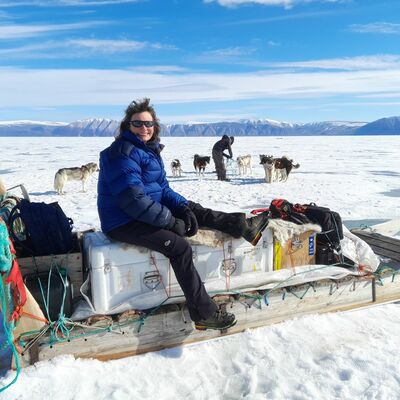
Friday means time for #FieldPhotoFriday (or if you prefer #FridayFieldworkPhoto #FridayFieldPhoto)
These were some of the first #IceFlowers I ever saw on #SeaIce this spring. Made me realise there was more going on in that part of the #Cryosphere than I'd imagined and I should pay it more attention!
Astonishingly beautiful and fragile, they grow on #SeaIceleads by evaporation+ condensation. Fascinating #FluidDynamics and surprisingly #salty tasting!
-

Friday means time for #FieldPhotoFriday (or if you prefer #FridayFieldworkPhoto #FridayFieldPhoto)
These were some of the first #IceFlowers I ever saw on #SeaIce this spring. Made me realise there was more going on in that part of the #Cryosphere than I'd imagined and I should pay it more attention!
Astonishingly beautiful and fragile, they grow on #SeaIceleads by evaporation+ condensation. Fascinating #FluidDynamics and surprisingly #salty tasting!
-

And this is basically how you can make experimental #fluiddynamics measurements such as #ParticleImageVelocimetry #PIV in fixed bed reactors used, e.g., as heterogenous catalytic reactors in the chemical industry.
---
RT @TheSpaceGal
Using the refractive index to make pennies float 🪄Impt safety note: dry water beads grow 100x their size (to what you see here), so be extra vigilant with the dry beads before they’ve grown around kids…
https://twitter.com/TheSpaceGal/status/1630628058519719937 -

Aflutter in the Breeze
Fabrics flutter in seemingly impossible ways in artist Thomas Jackson‘s images. But despite first appearances, each photograph is true to life; the fabrics are suspended on taut lines. Their dance is driven by wind energy, drag, tension, and flow–not manipulated pixels. I love the (turbulent) energy of them! (Image credit: T. Jackson; via Colossal)
#flapping #fluidDynamics #fluidSolidInteraction #fluidsAsArt #flutter #instability #physics #science #turbulence -

📄 Study Review
Basic Science and Pathogenesis
Deep belly breathing increases fluid movement between the brain and spine by 56% compared to normal breathing. The shift in brain blood flow also increases by 41%. Fluid exchange between head and spine is 10 times larger than within the brain.
Study type: Observational -

Jets From Impact
When a test tube of liquid hits a surface, the curvature of the meniscus focuses the rebounding fluid into a jet. In this video, researchers show some of the many variations they’ve explored on these experiments–from changing the depth of the fluid and the shape of the container, to changing the working fluid to honey or to dry grains. It’s a nice introduction to a fascinating phenomenon! (Video and image credit: H. Watanabe et al.; research credit: H. Watanabe et al. and K. Kobayashi et al.)
Animation showing how granular jets form in a test tube impact. #2025gofm #flowVisualization #fluidDynamics #jets #meniscus #physics #science #vibration #waterImpact -

Jets From Impact
When a test tube of liquid hits a surface, the curvature of the meniscus focuses the rebounding fluid into a jet. In this video, researchers show some of the many variations they’ve explored on these experiments–from changing the depth of the fluid and the shape of the container, to changing the working fluid to honey or to dry grains. It’s a nice introduction to a fascinating phenomenon! (Video and image credit: H. Watanabe et al.; research credit: H. Watanabe et al. and K. Kobayashi et al.)
Animation showing how granular jets form in a test tube impact. #2025gofm #flowVisualization #fluidDynamics #jets #meniscus #physics #science #vibration #waterImpact -
Quick-Drying, Fast-Cracking
Water droplets filled with nanoparticles leave behind deposits as they evaporate. Like a coffee ring, particles in the evaporating droplet tend to gather at the drop’s edge (left). As the water evaporates, the deposit grows inward (center) and cracks start to form radially. After just a couple minutes, the solid deposit covers the entire area of the original droplet and is shot through with cracks (right).
Researchers found that the cracks’ patterns and propagation are predictable through a model that balances the local elastic energy and and the energy cost of fracture. They also found that the spacing between radial cracks depends on the deposit’s local thickness. Besides explaining the patterns seen here, these cracking models could help analyze old paintings, where cracks could hide information about the artist’s methods and the artwork’s condition. (Image and research credit: P. Lilit et al.; via Physics Today)
#art #cracking #deposition #droplets #drying #evaporation #fluidDynamics #particleSuspension #physics #science
-
The Best of FYFD 2024
Welcome to another year and another look back at FYFD’s most popular posts. (You can find previous editions, too, for 2023, 2022, 2021, 2020, 2019, 2018, 2017, 2016, 2015, and 2014. Whew, that’s a lot!) Here are some of 2024’s most popular topics:
- The Taum Sauk Dam Failure and Its Legacy
- Stretching Ant Rafts
- Gigapixel Supernova
- Feynman’s Sprinkler Solved
- Calming the Waves
- “Dew Point” Deposits Droplets
- Drying Unaffected by Humidity
- Trapped in a Taylor Column
- Exciting a Flame in a Trough
- Remembering Rivers Past
- A Comet’s Tail
- Light Pillars
- Liquid Metal Printing
- The Miscible Faraday Instability
- A Triangular Prominence
This year’s topics are a good mix: fundamental research, civil engineering applications, geophysics, astrophysics, art, and one good old-fashioned brain teaser. Interested in what 2025 will hold? There are lots of ways to follow along so that you don’t miss a post.
And if you enjoy FYFD, please remember that it’s a reader-supported website. I don’t run ads, and it’s been years since my last sponsored post. You can help support the site by becoming a patron, buying some merch, or simply by sharing on social media. And if you find yourself struggling to remember to check the website, remember you can get FYFD in your inbox every two weeks with our newsletter. Happy New Year!
(Image credits: dam – Practical Engineering, ants – C. Chen et al., supernova – NOIRLab, sprinkler – K. Wang et al., wave tank – L-P. Euvé et al., “Dew Point” – L. Clark, paint – M. Huisman et al., iceberg – D. Fox, flame trough – S. Mould, sign – B. Willen, comet – S. Li, light pillars – N. Liao, chair – MIT News, Faraday instability – G. Louis et al., prominence – A. Vanoni)
#admin #ants #astrophysics #civilEngineering #comet #damFailure #drying #flowVisualization #fluidDynamics #fluidsAsArt #FYFD #instability #physics #plasma #rivers #rotatingFlow #science #selfExcitedOscillation #TaylorColumn #waveInterference
-
“There is a crack in everything…”
When millimeter-sized drops of water infused with nanoparticles dry, they leave behind complex and beautiful residues. As water continues evaporating, the residues warp, bend, and crack. In this video, researchers set their science to the music of Leonard Cohen. The results resemble blooming flowers and flying water fowl. If you’d like to learn more about the science behind the art, check out the two open-access papers linked below. (Video and image credit: P. Lilin and I. Bischofberger; submitted by Irmgard B.; see also P. Lilin and I. Bischofberger and P. Lilin et al.)
#coffeeRings #cracking #droplets #drying #evaporation #fluidDynamics #fluidsAsArt #granularMaterial #particleSuspension #physics #science
-

Drops on the Edge
Drops impacting a dry hydrophilic surface flatten into a film. Drops that impact a wet film throw up a crown-shaped splash. But what happens when a drop hits the edge of a wet surface? That’s the situation explored in this video, where blue-dyed drops interact with a red-dyed film. From every angle, the impact is complex — sending up partial crown splashes, generating capillary waves that shift the contact line, and chaotically mixing the drop and film’s liquids. (Video and image credit: A. Sauret et al.)
#2024gofm #crownSplash #dropletImpact #droplets #flowVisualization #fluidDynamics #fluidsAsArt #physics #science #wetting
-
Inside a Big Cat’s Roar
The roars of big cats — tigers, lions, jaguars, and leopards — carry long distances. In part, this reflects the animals’ size: large lungs exhale lots of air through a large voice-box, whose vibrations resonate in a large throat. But size alone does not make the roar. Below are examples of two big cat voice-boxes. On the left is the nonroaring snow leopard; on the right is the voice-box of a roaring jaguar. The red boxes labeled “VF” mark each cat’s vocal folds. Nonroaring cats have triangular folds, while roaring ones have thick square or rectangular vocal folds. These rectangular folds are more aerodynamically efficient, allowing them to produce a wider range of output levels. They’re also more resilient to the intense forces of a roar, thanks to the cushioning effect of fat deposits inside them. If interested, you can learn more over at Physics Today. (Image credit: tiger – T. Myburgh, voice box – E. Walsh and J. McGee; research credit: E. Walsh and J. McGee)
The vocal folds (VF) of nonroaring cats are triangular (left), whereas roaring cats have rectangular vocal folds (right).#acoustics #biology #cats #fluidDynamics #physics #roaring #science
-
Inside a Big Cat’s Roar
The roars of big cats — tigers, lions, jaguars, and leopards — carry long distances. In part, this reflects the animals’ size: large lungs exhale lots of air through a large voice-box, whose vibrations resonate in a large throat. But size alone does not make the roar. Below are examples of two big cat voice-boxes. On the left is the nonroaring snow leopard; on the right is the voice-box of a roaring jaguar. The red boxes labeled “VF” mark each cat’s vocal folds. Nonroaring cats have triangular folds, while roaring ones have thick square or rectangular vocal folds. These rectangular folds are more aerodynamically efficient, allowing them to produce a wider range of output levels. They’re also more resilient to the intense forces of a roar, thanks to the cushioning effect of fat deposits inside them. If interested, you can learn more over at Physics Today. (Image credit: tiger – T. Myburgh, voice box – E. Walsh and J. McGee; research credit: E. Walsh and J. McGee)
The vocal folds (VF) of nonroaring cats are triangular (left), whereas roaring cats have rectangular vocal folds (right).#acoustics #biology #cats #fluidDynamics #physics #roaring #science
-

Inside a Big Cat’s Roar
The roars of big cats — tigers, lions, jaguars, and leopards — carry long distances. In part, this reflects the animals’ size: large lungs exhale lots of air through a large voice-box, whose vibrations resonate in a large throat. But size alone does not make the roar. Below are examples of two big cat voice-boxes. On the left is the nonroaring snow leopard; on the right is the voice-box of a roaring jaguar. The red boxes labeled “VF” mark each cat’s vocal folds. Nonroaring cats have triangular folds, while roaring ones have thick square or rectangular vocal folds. These rectangular folds are more aerodynamically efficient, allowing them to produce a wider range of output levels. They’re also more resilient to the intense forces of a roar, thanks to the cushioning effect of fat deposits inside them. If interested, you can learn more over at Physics Today. (Image credit: tiger – T. Myburgh, voice box – E. Walsh and J. McGee; research credit: E. Walsh and J. McGee)
The vocal folds (VF) of nonroaring cats are triangular (left), whereas roaring cats have rectangular vocal folds (right).#acoustics #biology #cats #fluidDynamics #physics #roaring #science
-

Inside a Big Cat’s Roar
The roars of big cats — tigers, lions, jaguars, and leopards — carry long distances. In part, this reflects the animals’ size: large lungs exhale lots of air through a large voice-box, whose vibrations resonate in a large throat. But size alone does not make the roar. Below are examples of two big cat voice-boxes. On the left is the nonroaring snow leopard; on the right is the voice-box of a roaring jaguar. The red boxes labeled “VF” mark each cat’s vocal folds. Nonroaring cats have triangular folds, while roaring ones have thick square or rectangular vocal folds. These rectangular folds are more aerodynamically efficient, allowing them to produce a wider range of output levels. They’re also more resilient to the intense forces of a roar, thanks to the cushioning effect of fat deposits inside them. If interested, you can learn more over at Physics Today. (Image credit: tiger – T. Myburgh, voice box – E. Walsh and J. McGee; research credit: E. Walsh and J. McGee)
The vocal folds (VF) of nonroaring cats are triangular (left), whereas roaring cats have rectangular vocal folds (right).#acoustics #biology #cats #fluidDynamics #physics #roaring #science
-

Inside a Big Cat’s Roar
The roars of big cats — tigers, lions, jaguars, and leopards — carry long distances. In part, this reflects the animals’ size: large lungs exhale lots of air through a large voice-box, whose vibrations resonate in a large throat. But size alone does not make the roar. Below are examples of two big cat voice-boxes. On the left is the nonroaring snow leopard; on the right is the voice-box of a roaring jaguar. The red boxes labeled “VF” mark each cat’s vocal folds. Nonroaring cats have triangular folds, while roaring ones have thick square or rectangular vocal folds. These rectangular folds are more aerodynamically efficient, allowing them to produce a wider range of output levels. They’re also more resilient to the intense forces of a roar, thanks to the cushioning effect of fat deposits inside them. If interested, you can learn more over at Physics Today. (Image credit: tiger – T. Myburgh, voice box – E. Walsh and J. McGee; research credit: E. Walsh and J. McGee)
The vocal folds (VF) of nonroaring cats are triangular (left), whereas roaring cats have rectangular vocal folds (right).#acoustics #biology #cats #fluidDynamics #physics #roaring #science
-

How do vapor bubbles behave when water is below boiling?
Laser-induced bubbles offer a controlled way to probe nucleation and collapse dynamics far from equilibrium.
#phasechange #bubbledynamics #heattransfer #FluidPhysics #fluiddynamics
-
Inside Solidification
As children, we’re taught that there are three distinct phases of matter–solid, liquid, and gas–but the reality is somewhat more complicated. In the right–often exotic–conditions, there are far more phases matter takes on. In a recent study, researchers described a metal that sits somewhere between a liquid and a solid.
In a liquid, atoms are free to move. During solidification, atoms lose this freedom, and their frozen positions relative to one another determine the solid’s properties. Atoms frozen into orderly patterns form crystals, whereas those frozen haphazardly become amorphous solids. In their experiment, researchers instead observed atoms in liquid metal nanoparticles that remained stationary throughout the transition from liquid to solid. The number and position of stationary atoms affected whether the final solid crystallized or not.
By tracking these stationary atoms and their influence, the team hopes to better control the material properties of the final solidified metal. (Image credit: U. of Nottingham; research credit: C. Leist et al.; via Gizmodo)
#amorphousSolid #fluidDynamics #materialScience #phaseChange #physics #science #solidification -

Recreating Atmospheres
In planetary atmospheres, energy and vorticity can cascade from large scales to smaller ones, but the mechanics of this transfer remain somewhat elusive. In a recent experiment, researchers built a lab-scale representation of an atmosphere using a meter-scale rotating annular tank. The outer bottom edge of the tank gets heated–representing the sun’s warming at the equator–while a pipe in the center of the tank gets cooled near the tank surface, which mimics the chilling effect of the poles. Researchers filled the tank with a water-glycerol mixture and recorded how their artificial atmosphere responded at different rotation rates.
Two different rotating atmospheres, colored by vorticity (red clockwise, blue counterclockwise). The left version has a slower rate of rotation, and thus larger length scales.The results show an energy spectrum that’s consistent with atmospheric observations–with a steep drop at large length scales and a flatter one at smaller scales. But interestingly, they also found that the cascade was temperature-dependent in ways that current models don’t predict. Untangling that effect could help us understand not only our atmosphere but those of other planets. (Image credit: tank – H. Scolan, animation – S. Ding et al.; research credit: S. Ding et al.; via APS)
#atmosphericScience #energyCascade #flowVisualization #fluidDynamics #physics #planetaryScience #rotatingFlow #science #turbulence #vorticity -
Recreating Atmospheres
In planetary atmospheres, energy and vorticity can cascade from large scales to smaller ones, but the mechanics of this transfer remain somewhat elusive. In a recent experiment, researchers built a lab-scale representation of an atmosphere using a meter-scale rotating annular tank. The outer bottom edge of the tank gets heated–representing the sun’s warming at the equator–while a pipe in the center of the tank gets cooled near the tank surface, which mimics the chilling effect of the poles. Researchers filled the tank with a water-glycerol mixture and recorded how their artificial atmosphere responded at different rotation rates.
Two different rotating atmospheres, colored by vorticity (red clockwise, blue counterclockwise). The left version has a slower rate of rotation, and thus larger length scales.The results show an energy spectrum that’s consistent with atmospheric observations–with a steep drop at large length scales and a flatter one at smaller scales. But interestingly, they also found that the cascade was temperature-dependent in ways that current models don’t predict. Untangling that effect could help us understand not only our atmosphere but those of other planets. (Image credit: tank – H. Scolan, animation – S. Ding et al.; research credit: S. Ding et al.; via APS)
#atmosphericScience #energyCascade #flowVisualization #fluidDynamics #physics #planetaryScience #rotatingFlow #science #turbulence #vorticity -
Recreating Atmospheres
In planetary atmospheres, energy and vorticity can cascade from large scales to smaller ones, but the mechanics of this transfer remain somewhat elusive. In a recent experiment, researchers built a lab-scale representation of an atmosphere using a meter-scale rotating annular tank. The outer bottom edge of the tank gets heated–representing the sun’s warming at the equator–while a pipe in the center of the tank gets cooled near the tank surface, which mimics the chilling effect of the poles. Researchers filled the tank with a water-glycerol mixture and recorded how their artificial atmosphere responded at different rotation rates.
Two different rotating atmospheres, colored by vorticity (red clockwise, blue counterclockwise). The left version has a slower rate of rotation, and thus larger length scales.The results show an energy spectrum that’s consistent with atmospheric observations–with a steep drop at large length scales and a flatter one at smaller scales. But interestingly, they also found that the cascade was temperature-dependent in ways that current models don’t predict. Untangling that effect could help us understand not only our atmosphere but those of other planets. (Image credit: tank – H. Scolan, animation – S. Ding et al.; research credit: S. Ding et al.; via APS)
#atmosphericScience #energyCascade #flowVisualization #fluidDynamics #physics #planetaryScience #rotatingFlow #science #turbulence #vorticity -
Recreating Atmospheres
In planetary atmospheres, energy and vorticity can cascade from large scales to smaller ones, but the mechanics of this transfer remain somewhat elusive. In a recent experiment, researchers built a lab-scale representation of an atmosphere using a meter-scale rotating annular tank. The outer bottom edge of the tank gets heated–representing the sun’s warming at the equator–while a pipe in the center of the tank gets cooled near the tank surface, which mimics the chilling effect of the poles. Researchers filled the tank with a water-glycerol mixture and recorded how their artificial atmosphere responded at different rotation rates.
Two different rotating atmospheres, colored by vorticity (red clockwise, blue counterclockwise). The left version has a slower rate of rotation, and thus larger length scales.The results show an energy spectrum that’s consistent with atmospheric observations–with a steep drop at large length scales and a flatter one at smaller scales. But interestingly, they also found that the cascade was temperature-dependent in ways that current models don’t predict. Untangling that effect could help us understand not only our atmosphere but those of other planets. (Image credit: tank – H. Scolan, animation – S. Ding et al.; research credit: S. Ding et al.; via APS)
#atmosphericScience #energyCascade #flowVisualization #fluidDynamics #physics #planetaryScience #rotatingFlow #science #turbulence #vorticity -

Recreating Atmospheres
In planetary atmospheres, energy and vorticity can cascade from large scales to smaller ones, but the mechanics of this transfer remain somewhat elusive. In a recent experiment, researchers built a lab-scale representation of an atmosphere using a meter-scale rotating annular tank. The outer bottom edge of the tank gets heated–representing the sun’s warming at the equator–while a pipe in the center of the tank gets cooled near the tank surface, which mimics the chilling effect of the poles. Researchers filled the tank with a water-glycerol mixture and recorded how their artificial atmosphere responded at different rotation rates.
Two different rotating atmospheres, colored by vorticity (red clockwise, blue counterclockwise). The left version has a slower rate of rotation, and thus larger length scales.The results show an energy spectrum that’s consistent with atmospheric observations–with a steep drop at large length scales and a flatter one at smaller scales. But interestingly, they also found that the cascade was temperature-dependent in ways that current models don’t predict. Untangling that effect could help us understand not only our atmosphere but those of other planets. (Image credit: tank – H. Scolan, animation – S. Ding et al.; research credit: S. Ding et al.; via APS)
#atmosphericScience #energyCascade #flowVisualization #fluidDynamics #physics #planetaryScience #rotatingFlow #science #turbulence #vorticity -
Making Bubbles in Magma
When bubbles form in magma deep below the earth, volcanic eruptions follow. Scientists believe this happens when decompression of the magma allows volatile compounds to come out of solution and form bubbles–just as opening a bottle of seltzer allows carbon dioxide to bubble out. But a new study indicates that decompression may not be the only source of bubbles.
The team found that supersaturated fluids can nucleate bubbles when they’re sheared–even without decompression. They demonstrated this in the lab, not with magma but with a low-temperature magma analog, seen above. The more saturated with volatiles the fluid is, the less shear is needed to trigger bubbles.
Viscous shear is everywhere for magma, so this bubble formation mechanism is likely common. Better understanding how and when bubbles form in magma directly affects predictions for eruptions–especially for determining whether they’re likely to be explosive or effusive. (Image credit: volcano – A. Bonnerdeaux, experiment – O. Roche et al.; research credit: O. Roche et al.; via Physics World)
#bubbles #eruption #fluidDynamics #geophysics #magma #nucleation #physics #science #shear #volcano -
Schooling at Scale
Relatively simple visual and hydrodynamic signals are enough to make digital fish school in ways that resemble living ones. Here, researchers look at what happens when well-behaved schools of fish get too big. The researchers first demonstrate that their schools behave reasonably at one hundred members, either in a schooling configuration or a group milling around a central region.
At one thousand fish, the schools are still reasonably coherent and sensible. But at fifty thousand fish, the picture is drastically different. Neither schooling nor milling groups are able to remain together. They fracture and scatter into smaller groupings. (Video and image credit: H. Hang et al.)
#2025gofm #activeMatter #biology #collectiveMotion #fish #fluidDynamics #instability #numericalSimulation #physics #schooling #science -
Fluid Flows Break Up Microswimmer Clumps
The field of active matter looks at the collective motion of particles and organisms–how birds flock and fish school. In systems of “dry” squirmers–those that have no hydrodynamic interactions with one another–clumps of squirmers can form with empty spaces in between them. This is known as motility-induced phase separation, or MIPS. Researchers wondered whether microswimmers in a fluid–which do produce hydrodynamic forces that can affect one another–would also show MIPS.
In a new study, researchers show, instead, that hydrodynamic interactions between swimmers will prevent (or destroy) these clumps. Through a combination of theoretical work and simulation, the authors found that translational flows between swimmers swept the swimmers out of clumps as they formed. Rotational flows between swimmers made them able to change direction faster, which also kept stable clumps from forming. (Image and research credit: T. Zhou and J. Brady; via APS)
Hydrodynamic interactions destroy clumps of microswimmers. This simulation shows microswimmers that are initially in a clumped formation before hydrodynamic interactions are “turned on”. Once the swimmers can affect one another through the flows their motion creates, the clumps quickly break apart. #activeMatter #biology #collectiveMotion #fluidDynamics #hydrodynamics #microswimmers #phaseSeparation #physics #science -
Crowd Vortices
The Feast of San Fermín in Pamplona, Spain draws crowds of thousands. Scientists recently published an analysis of the crowd motion in these dense gatherings. The team filmed the crowds at the festival from balconies overlooking the plaza in 2019, 2022, 2023, and 2024. Analyzing the footage, they discovered that at crowd densities above 4 people per square meter, the crowd begins to move in almost imperceptible eddies. In the animation below, lines trace out the path followed by single individuals in the crowd, showing the underlying “vortex.” At the plaza’s highest density — 9 people per square meter — one rotation of the vortex took about 18 seconds.
The team found similar patterns in footage of the crowd at the 2010 Love Parade disaster, in which 21 people died. These patterns aren’t themselves an indicator of an unsafe crowd — none of the studied Pamplona crowds had a problem — but understanding the underlying dynamics should help planners recognize and prevent dangerous crowd behaviors before the start of a stampede. (Image credit: still – San Fermín, animation – Bartolo Lab; research credit: F. Gu et al.; via Nature)
#activeMatter #collectiveMotion #crowds #fluidDynamics #physics #science #vortices